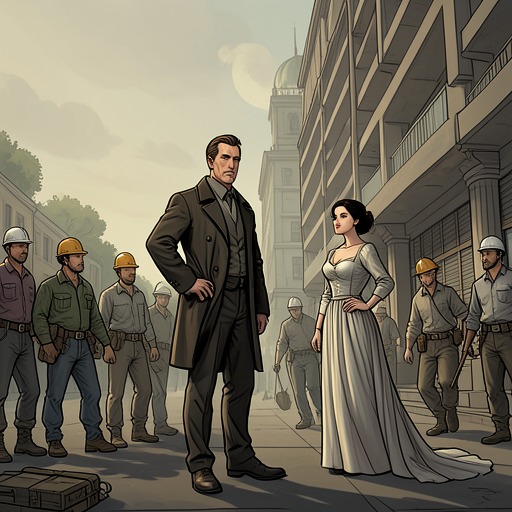
Oretea foundry
The Florios of SicilyThe Oretea foundry is the ironworks Vincenzo Florio buys and tries to turn into a major industrial enterprise in Palermo. It is at once a practical extension of his shipping and manufacturing interests and a wager on Sicily’s ability to build rather than merely import. Its planned furnaces, machinery, and shipbuilding support make the foundry a measure of Vincenzo’s confidence; its shortages, contractual penalties, and exposure to revolt show how little control even a determined merchant has over the conditions of production.
Origins and Industrial Ambition
Vincenzo acquires the foundry from the Sgroi brothers, despite the prevailing belief that a workshop of this scale cannot succeed in Palermo, where people assume only small shops can survive. He treats the purchase not as a speculative ornament but as a way to create productive capacity on the island. When others call him a visionary, he says he will answer them with facts: tuna is already being canned and sold, demand is growing, and he expects the business to expand; the foundry, likewise, can demonstrate that Palermo is capable of more than putìe.
The industrial case is closely tied to the Florios’ maritime operations. Vincenzo tells Carlo Giachery that a foundry of their own, working for their ships, would reduce the cost of spare parts and other needs once vessels are made of metal and powered by steam. To him, the investment links manufacturing to shipping: local ironworking could make the fleet less dependent on outside supply and help move the island beyond its existing limits. He recalls the bark grinder the Florios introduced and the insults they faced when they entered the quinine-powder trade, treating that earlier innovation as precedent for another challenge to established assumptions.
Construction, Work, and Obstacles
The enterprise demands sustained practical attention as well as vision. Vincenzo spends a day at the foundry speaking with workers and checking that coal, iron, and tin will arrive in time. Yet the supply chain does not obey his plans. The foundry displays a steam press at an exhibition—the first hydraulic press built in Sicily—and receives an order for pans and spoons that it cannot fulfill within a month. There is not enough coal locally, so Vincenzo must order more from France; the ships meant to carry it fail to arrive, putting the foundry at risk of a contractual penalty.
The difficulty is not simply managerial. The plant depends on imported fuel and transport, while the promised work schedule and delivery obligations leave little room for interruption. Ben Ingham has withdrawn from the business, and Giulia recognizes that Vincenzo knew a foundry in Palermo would not be easy to manage. Her touch calms him as he tries to locate documents relevant to the penalties, but she stops listening before he can finish explaining. The scene leaves the industrial project caught between ambitious contracts and material dependencies beyond the owners’ immediate command.
Revolt and Physical Vulnerability
Political violence exposes a different weakness: the foundry’s location and stored materials make it vulnerable to conflict. When cannon fire from the sea confirms that fighting has reached Palermo, Vincenzo leaves his office, orders the aromateria secured, and sets out to protect the foundry by having its gates barred and its most important tools put away. He is stopped before he can reach it. With the fighting under way, the works near Porta San Giorgio might as well be on Malta.
The danger is concrete. A new plant built four years earlier is packed with iron and coal and contains abundant flammable material. Vincenzo cannot bring himself to imagine what the battle might do to it. The foundry is therefore not only an emblem of long-term industrial aspiration but a vulnerable concentration of capital, supplies, and labor, exposed to events that can interrupt production or destroy the investment outright.
Political Use and Lasting Significance
The foundry’s role changes as control of the island shifts. During the struggle against Bourbon rule, its productive capacity serves a military purpose: Vincenzo tells Garibaldi’s representative that the works have produced cannons for the Red Shirts. He says it was his duty as a Sicilian, and adds that once his workers understood the guns would be aimed at the Bourbons, they did not mind how long they worked. The factory that had been conceived as a means of supporting ships thus becomes an instrument of the revolt.
After Italian unification, the Oretea foundry remains part of the Florios’ broader industrial and financial world. Vincenzo is president of the Palermo branch of the National Bank, while his son Ignazio works with him; the family’s commercial interests continue to span production, shipping, and finance. The foundry’s significance lies in that combination of aspiration and exposure. It represents Vincenzo’s effort to build industrial capacity in Sicily, but every stage—from imported coal and delayed ships to cannon fire and political realignment—shows how production is bound to transport, state power, and the unstable conditions of the island.